Detect drift. Prove impact. Validate the repair.
Monitor APIs, webhooks, scheduled feeds, and queues for drift. Reproduce failures from approved evidence, then validate bounded repairs before delivery.
Runs outside your request path. Fails open. Stores structure, never raw payloads.

The problem
The change
Providers rename fields, change auth, and reorder events without telling you.
The signal
Your uptime checks stay green, because every request still returns 200.
The discovery
You find out from a customer, or during unrelated work, days later.
One incident, one evidence chain
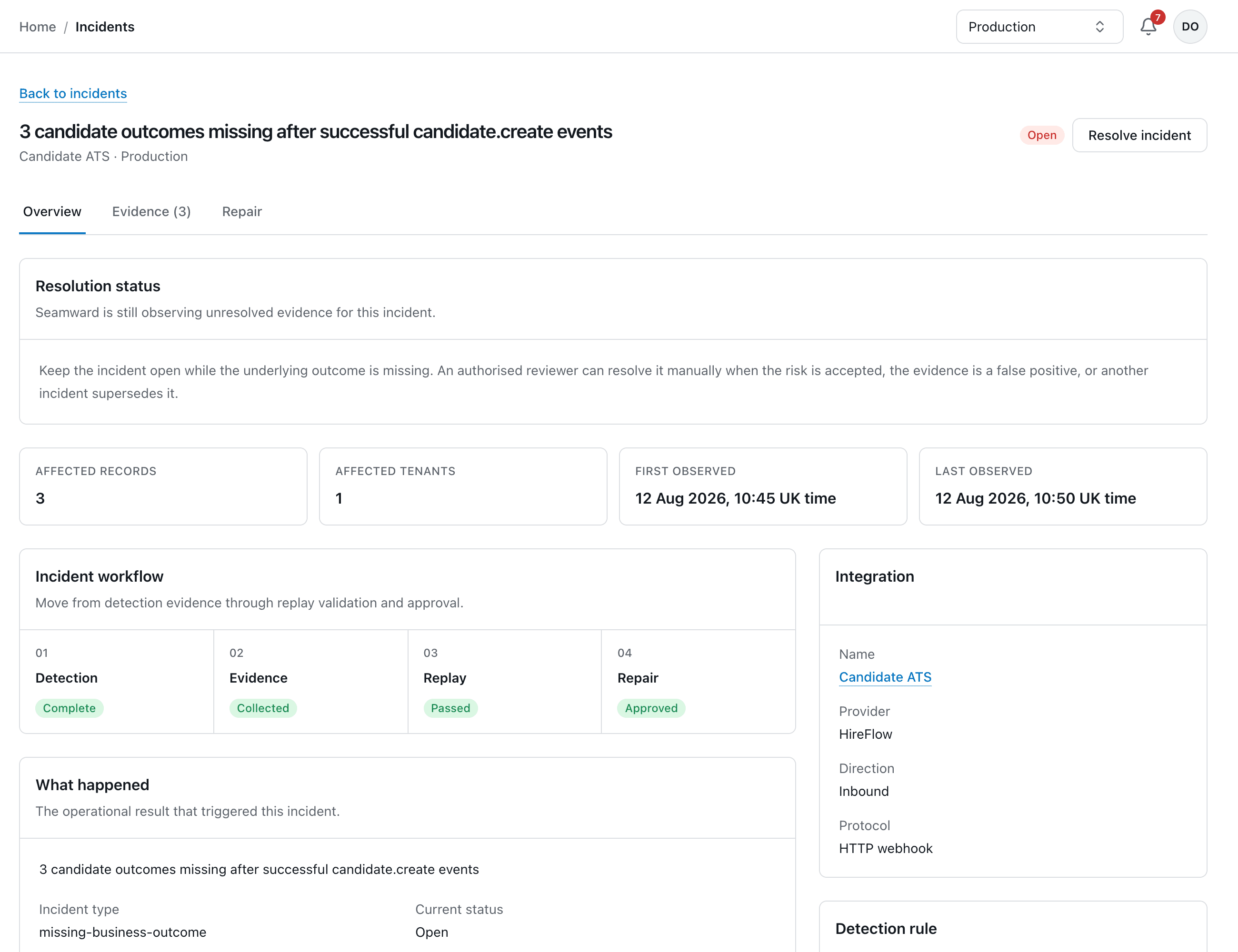
What Seamward does with a webhook that succeeded and still failed
- 01complete
Detection
The provider renamed
email_addresstocandidate_email. Seamward compared observed shape with the declared contract and raised the finding on the exact path,$.email_address.42 samples · 12 Aug 2026, 10:50 UK time
- 02collected
Evidence
Three
candidate.createevents were accepted with a 202. Three candidate records never appeared. Seamward linked each observation to the missing outcome and opened one incident: one tenant, three records, three redacted evidence entries.3 affected records · 1 tenant · redacted IDs and hashes
- 03passed
Replay
The same redacted evidence became an immutable fixture set. The current adapter failed every fixture. The candidate fix passed every fixture. The runner had no network, 64 MB of memory, and five seconds.
child process · network denied · 64 MB · 5 s
- 04approved
Repair
The proposal maps
$.candidate_emailback to$.email_address. Deterministic validation signed off. Your team recorded the approval. Nothing was deployed, and no customer code was changed.deterministic · low risk · approved 17 Aug 2026
The approved repair
Every claim on the card is checked before you see it
The mapping, its assumptions, the before and after replay, and the deterministic checks sit on one card. Approval records a decision. It does not deploy.
The approved evidence chain can then become a GitHub issue or draft pull request for your normal review.
bounded mapping
- incident
- 3 candidate outcomes missing · 1 tenant
- dataset
- rds_seed_candidate_missing · 3 immutable fixtures
- isolation
- child process · network denied · 64 MB · 5 s
- source
- deterministic · no AI provider used
before repair
failed
0/ 3 fixtures
proposed repair
passed
3/ 3 fixtures
deterministic checks · 8 of 8 passed
- Supported proposal format
- Bounded operation count
- Supported operations only
- Safe field paths
- Distinct source and target fields
- Linked to incident evidence
- Operations justified by cited evidence
- Within approval risk policy
Approved by Demo Owner · workspace owner · 17 Aug 2026
sha256:9f2c…c41d
Replay fixtures and schema checks support this bounded mapping.
What Seamward will not do
Automation stops where your judgement starts
It never sits in your request path.
The collector observes after execution. If Seamward is down, your integration is not.
It never stores raw payloads by default.
Redaction and hashing happen in your process, before anything leaves it.
It never validates against live systems.
Replay runs in an isolated child process with no network access.
It never deploys.
A model can propose and explain. Deterministic validation decides. You approve. Delivery is a reviewable artifact in GitHub, not a change in production.
Instrument in one call
Observe the integrations you already run
Wrap an integration after its normal execution path. Redaction runs in your process, so what leaves it is structure.
- Node.js collector
- Shipped
- Laravel and PHP collectors
- Public alpha
- REST ingestion from any runtime
- Shipped
import { createSeamwardCollector } from "@seamward/collector";

const webhookCollector = createSeamwardCollector({
  connectionKey: process.env.SEAMWARD_CONNECTION_KEY,
  ingestToken: process.env.SEAMWARD_INGEST_TOKEN,
  deployment: { service: "candidate-api", commitSha: process.env.GITHUB_SHA },
});

// Wrap the handler you already have. The response you return is what your
// caller receives. Seamward records structure after it has been sent.
export const handleCandidateWebhook = webhookCollector.observeWebhook(
  { routeTemplate: "/webhooks/candidates" },
  async (payload) => {
    const candidate = await candidateService.accept(payload);

    return {
      statusCode: 202,
      eventType: "candidate.create",
      outcome: {
        accepted: true,
        businessObjectType: "candidate",
        businessObjectId: candidate.id,
      },
    };
  },
);- Quick startSend the first safe observation and confirm ingestion.
- Node.js collectorInstrument inbound webhooks and outbound API calls.
- PHP collector coreBuild a custom PHP adapter on the framework-neutral core.
- Laravel collectorUse named connections, middleware, and HTTP wrappers.
- REST ingestionPost redacted observations from another runtime.
- GitHub AppConfigure reviewed issue and draft pull request delivery.
- MCPConnect approved development tools to Seamward context.
- API referenceReview authentication, endpoints, and request shapes.
Built for
Teams that depend on APIs they do not control
If you have more than five external integrations and the last provider change surprised you, this is for you.
Recruitment and HR
applicant tracking systems
Fintech
payment and banking providers
Marketplaces
partner webhooks
Logistics
carrier and partner feeds
Early access
Bring us the integration failure you need to prove
Seamward is onboarding teams with real third-party reliability problems. Start with one integration.
Runs outside your request path. Fails open. Stores structure, never raw payloads.